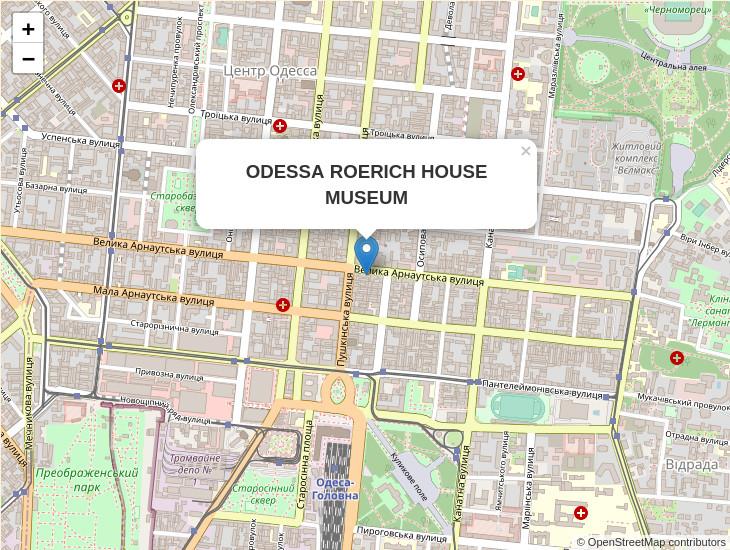
Visit us
Tuesday - Sunday:
10:00 a.m. - 6:00 p.m.
Closed: Monday
The range of Roerich's activities was unusually wide. He was an artist, archaeologist, ethnographer, lawyer, geographer, historian, as well as writer, philosopher, and traveler. Nicholas Roerich created more than 7000 paintings. He had worked in the field of monumental and applied art. He is known as the author of scenography and had made a series of sketches for costumes, furniture, embroidery, etc. All his diverse heritage is marked with his remarkable original talent.
Nicholas Roerich w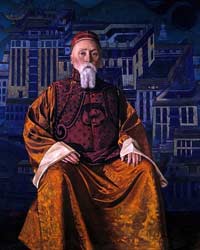 as formed as an artist and public figure of culture in the late XIX - early XX centuries. After graduating from St. Petersburg University and the Academy of Arts, he began to study the culture of Russia. His backgroung in history, numerous archaeological excavations, "walking in Russian antiquity" helped Roerich to find a new edge of reflection of the native nature image. As well as the stages of development of the thousand-year history of the Russian people. The peculiar worldview of Nicholas Roerich was based on the belief that raising the spiritual culture of the masses can transform life on the Earth, defeat ignorance, vulgarity, and wars: "Where there is culture, there is peace ... While the culture is a luxury only ... it will not rebuild a life. Culture should enter the immediate everyday life of both the hut and the palace. "
The Roerich Pact (1935) often referred to as "The Red Cross of Culture" stipulates in Article 1: "The historic monuments, museums, scientific, artistic, educational and cultural institutions shall be considered as neutral and as such respected and protected by belligerents. The same respect and protection shall be due to the personnel of the institutions mentioned above. The same respect and protection shall be accorded to the historic monuments, museums, scientific, artistic, educational and cultural institutions in time of peace as well as in war." The 1954 Hague Convention for the Protection of Cultural Property in the Event of Armed Conflict was based on the Roerich pact and is a part of International Humanitarian Law. As of June 2018, 132 states are party to the Hague Convention of 1954, 109 and 77 states respectively have acceded to the Protocols of 1954 and 1999.
Exploring ancient Russian art, Nicholas Roerich became interested in the issue of resettlement of peoples and the mutual influence of cultures. His special attention was attracted by India. The artist developed extensive plans for travels to the East, which he carried out together with his wife Helena Roerich, sons George and Svyatoslav. The three research expeditions carried out by the Roerich family have collected many ancient manuscripts, works of art, unique materials on archeology, botany, geology, philosophy, linguistics, medicine, etc.
In 1928, Nicholas Roerich founded the Himalayan Institute for Scientific Research "Urusvati" ("The Light of the Morning Star") in India. While working in India, the artist had created a large number of paintings and graphic works that reveal the beauty of the eastern mountains, valleys, rocky placers. Indira Gandhi noted that "they captured the spirit of the Himalayas and the spirit of India." According to Nicholas Roerich, the majestic beauty of nature is that eternal source that elevates and ennobles the human soul that "at least a mental introduction to solemn greatness will be the best strengthening cure." The Indian landscapes of Nicholas Roerich are characterized by a heroic and poetic interpretation of nature, monumentality, decorativeness, and laconicism. The composition of each work is strictly thought out and balanced. The artist developed a peculiar catchy coloristic palette, which we now call “Roerich's” - blue, turquoise, lilac, pink, amber-yellow colors of different aperture.
In 1947, the artist was preparing to return to his homeland. Books and paintings were packed, but he didn't get time. His ashes were scattered near his house in Kulu (India). The main part of the creative heritage of the master returned to Russia. A large portion of his works belongs to the State Russian Museum, the State Tretyakov Gallery and the International Roerich Center in Moscow.
Visit us
Tuesday - Sunday:
10:00 a.m. - 6:00 p.m.
Closed: Monday